360-icon download left-arrow left-doublearrow nav-dot pdf-icon rss-icon search-icon spot-icon subnavi-icon close-icon info-icon
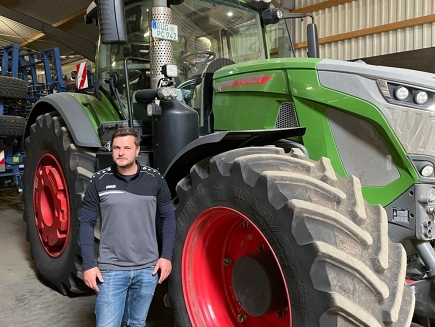
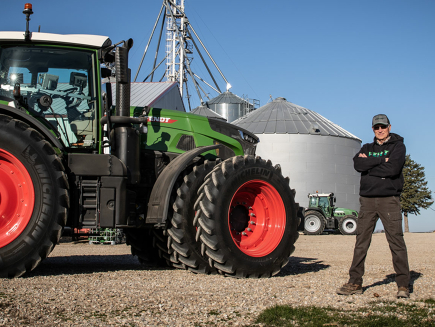
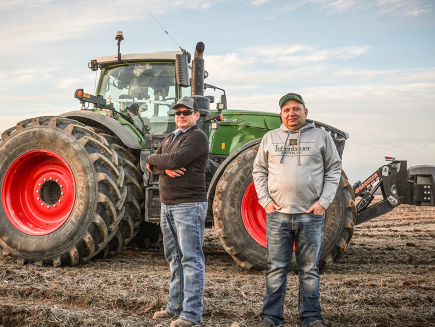
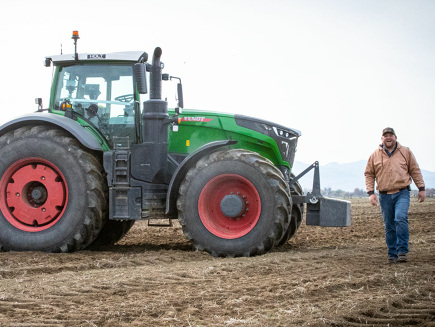
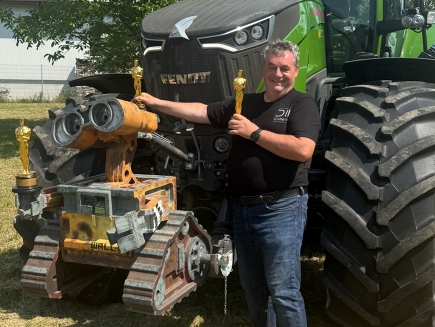
Gerd Nefzer in front of his Fendt 900 Vario tractor, his 3 Oscars and Wall-e from the movie

The tractors are all-terrain and combine high power with a high payload.

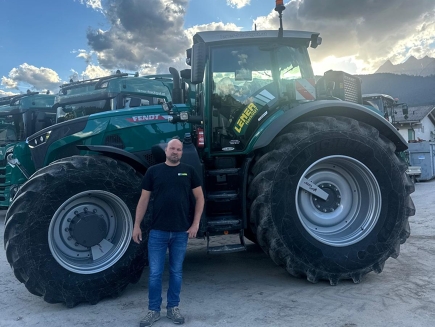
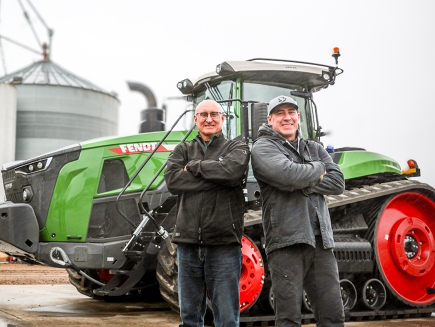
Gerd Nefzer, Nefzer Special Effects GmbH, Schwäbisch Hall, Germany, with a Fendt 933 Vario and Fendt 939 Vario

The tractors are all-terrain and combine high power with a high payload.

Oscar-worthy special effects with a Fendt 900 Vario

It’s 50 degrees outside in the Jordanian desert. Headlights are flickering, cameras are rolling and a wind machine is humming loudly. Right in the thick of it is Gerd Nefzer with his Fendt tractors.
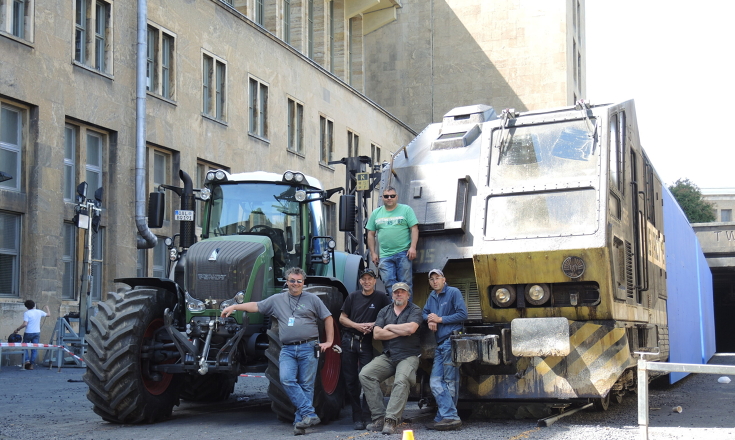
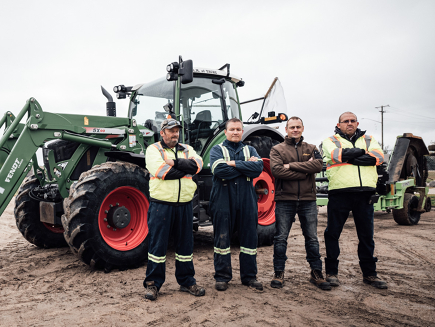
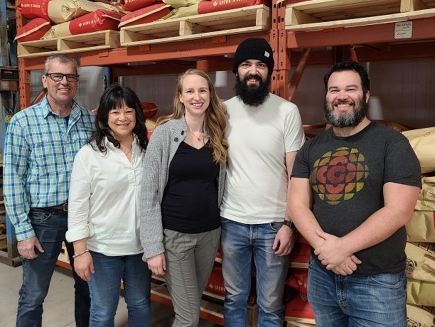
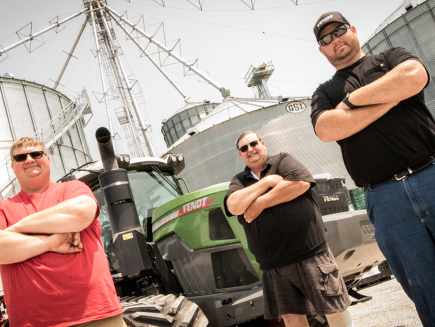
Five team members standing proudly in front of a Fendt 900 Vario tractor at Nefzer Special Effects GmbH. An old warehouse building can be seen in the background.

From the field to the film set

Gerd Nefzer has taken an unusual path for a trained agricultural technician and farmer, going from the field to the film set. He has been working on film sets and creating special effects since the 1980s. In 1968, his father-in-law established what is now Nefzer Special Effects GmbH by renting out film cars and props. Today, Gerd Nefzer provides technology and ideas for Hollywood’s biggest productions. He has won three Oscars and three British Academy Film Awards (BAFTAs) for his work on “Blade Runner 2049”, “Dune: Part One” and “Dune: Part Two”.


You can find out more about the use of tractors in “Blade Runner 2049” or “Narnia” here:

For the blockbusters “Dune: Part One” and “Dune: Part Two, a Fendt 933 Vario was used to generate wind of just the right strength and from the perfect direction. The same tractor was also used to stage a spaceship crash in the desert landscape of Dune. The special effects expert constructed a rig comprising ropes and pulleys, enabling the tractor to pull the spaceship precisely along the intended trajectory without itself appearing in the shot.

In other productions, Nefzer has made cars sink slowly into water, created storms and explosions, and made a crate levitate. “For the floating crate, we used the hydraulics of the Fendt 933 Vario. We fitted a hydraulic cylinder inside the crate, which we could control via the tractor. That’s how we created the effect of a floating crate,” explains the 61-year-old.

Why Fendt? he answer is pragmatic: the tractors are all-terrain and combine high power with a high payload. The Fendt Vario continuously variable transmission also makes them highly versatile. What if a stuntman has to take over? They’re easy to drive.
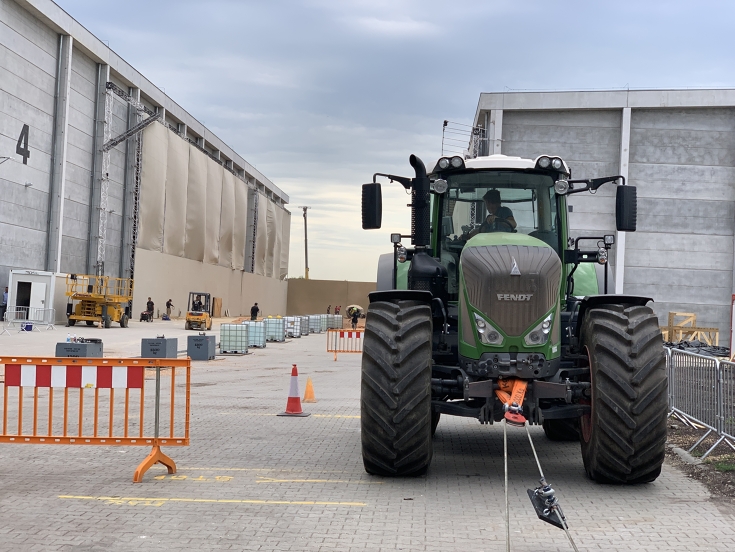
Fendt 900 Vario repeatedly driving the same route on a film set to ensure precise, repeatable movements for special effects and multiple camera angles.

Same scene, same track – thanks to FendtONE

A car crash on the road. The scene must look identical from every angle and at every moment. Gerd Nefzer achieves this using the onboard track guidance in FendtONE: he sets a line and follows it exactly with the tractor, towing the car on a rope. Once, twice, five times. This ensures there are no deviations that would be noticeable later in the edit.


For high-speed scenes, Nefzer employs pulleys and ropes to achieve a 2:1 ratio. At a tractor speed of 40 km/h, the towed vehicle reaches 80 km/h. This saves fuel and is safer than actually driving a car at 80 km/h across a film set. The continuously variable Vario transmission plays a key role here: accelerating smoothly without any jolts from gear changes. This means: no load peaks and no jerky movements on the rope.

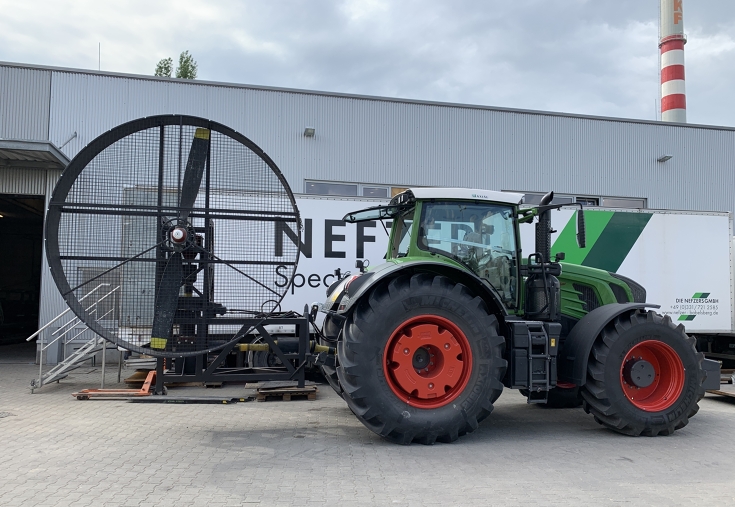
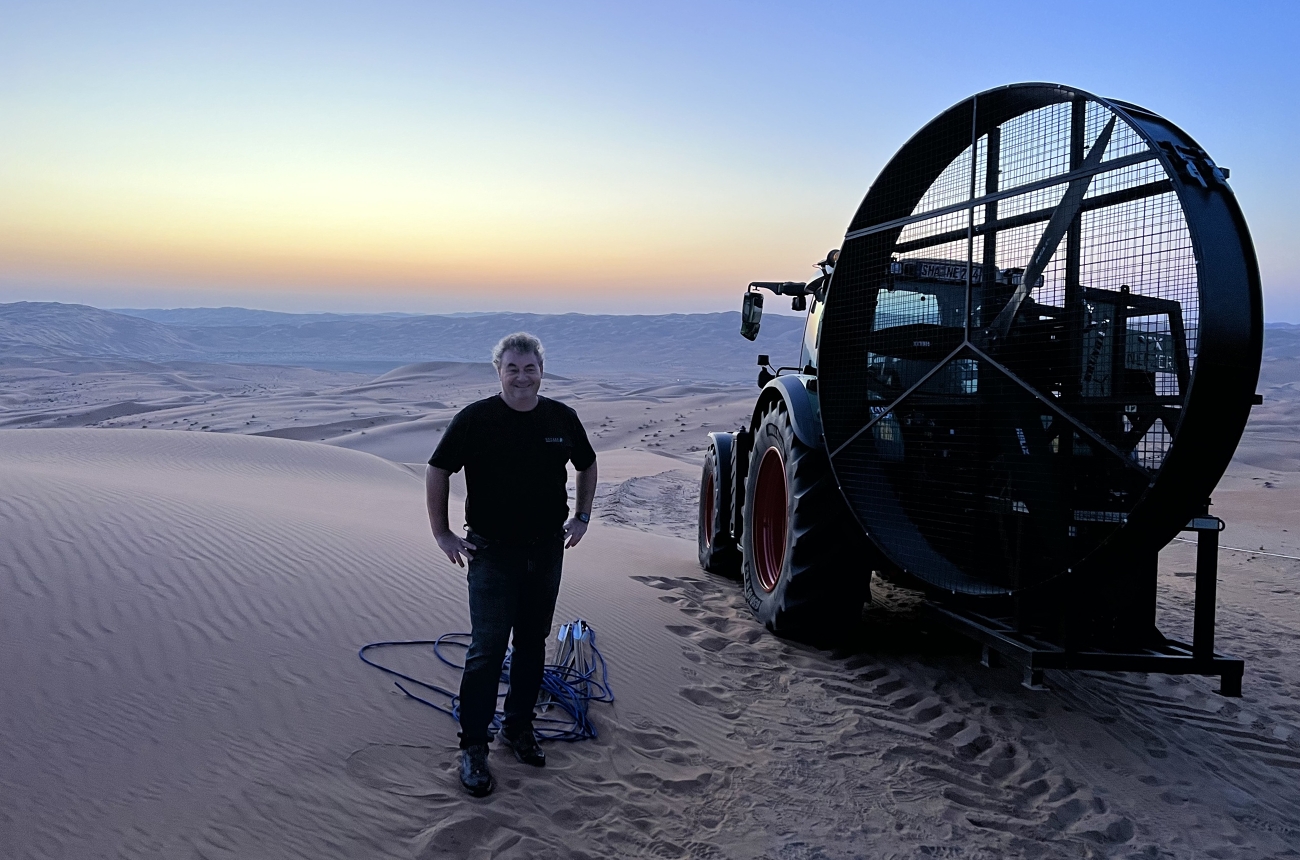
A Fendt 933 Vario tractor powers a large wind machine used to create special effects for the blockbuster films Dune: Part One and Dune: Part Two.

Wind on script

Gerd Nefzer has built four wind machines himself. Unlike conventional machines, these are not powered by aircraft engines, but by Fendt tractors ranging from 110 to 400 hp. The advantage of this is that traditional wind machines with aircraft engines often stand idle for weeks or months until they are needed again and require a great deal of maintenance. “With our Fendt tractors, the unreliable aircraft engine is no longer needed,” says Nefzer. “I simply hook the wind machine – which weighs up to 1.5 tonnes – into the three-point hitch at the rear of the tractor.” The Fendt Vario transmission and the PTO shaft give him full control: how much wind comes from which direction? Stronger, weaker, steady? “Thanks to the Vario transmission and the PTO shaft, I can control my wind machines precisely and increase or decrease the wind,” he explains. Compared to a truck, there’s another advantage: the tractor is all-terrain – whether in the desert, the forest or on a mountainside.

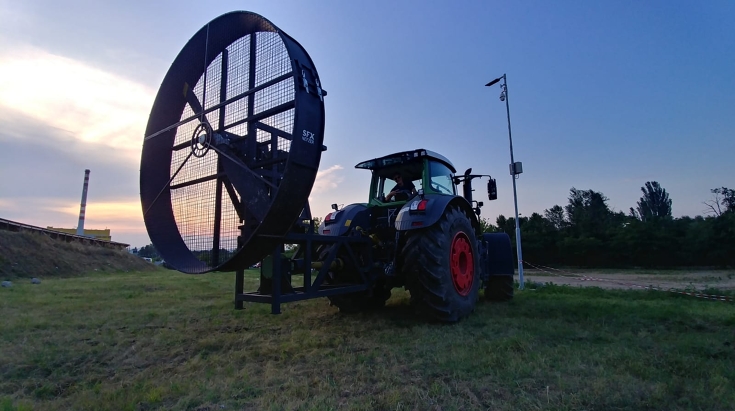
Fendt 939 Vario with Wind Machine

The 900 really gets the wind blowing

In 2025, he bought a new Fendt 939 Vario. Before that, he had hired a Fendt 933 Vario for a shoot in Hungary. “That worked really well, but the new one has VarioDrive, over 380 hp and the reversible fan. This helps us when working in challenging terrain, such as in the desert or in the forest,” says Gerd Nefzer. The reversible fan particularly useful in the desert: it requires less maintenance and cleaning, and ensures that the equipment will run reliably even under extreme conditions. The higher power output brings another advantage: more wind in front of the camera.

Around the world in over 80 days

“My tractors probably travel further than any others around the world,” laughs the special effects expert. Depending on the filming location, he either hires machinery locally or ships machines from his own fleet. His Fendt 209 Vario was once even flown from Abu Dhabi to Germany in a Boeing cargo plane. “But that’s very labour-intensive. The fuel tank has to be completely empty and a lot of preparation is required”, says Nefzer. More often, his tractors travel by ship, as was recently the case to the United Arab Emirates: the wind machine was placed in a container, while the tractors drove onto the ship under their own power (roll-on-roll-off). This sometimes takes considerably longer than 80 days and requires planning well in advance of the first take.

Gerd Nefzer has already finished shooting his next film. He is not yet allowed to reveal what his Fendt tractors did on set.