Choosing a versatile tractor capable of keeping up with a variety of arable, road and yard work is a tricky challenge. The safe option has been to choose a 200 horsepower plus six- cylinder machine, but Matthew Mackay has bucked the trend by opting for a four-cylinder Fendt 620.
A mixed farm near Nairn
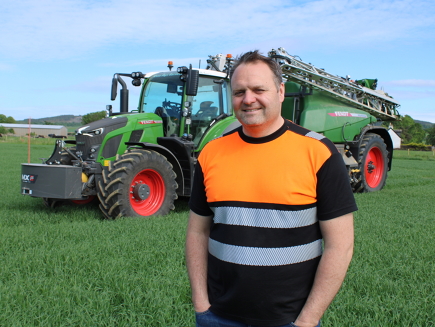
4th generation Matthew farms in partnership with his parents near Nairn. Brackla Farm extends to 1200 acres and is home to 75 Angus store cattle and two chicken sheds housing 80,000 laying hens.
Keeping on top of 1000 acres of arable on undulating land is no small task but Matthew has found the 620 Vario every bit as capable as the 700 series S4 and Gen6 models in his fleet. The arable land is split between 650 acres of barley, 250 acres of wheat and 100 acres of green manure which is farmed alongside 200 acres of grassland which provides forage, grazing land and a ranging area for the hens.
“We have two older S4 716 Power models that have served us well and have 7000 and 8000 hours on them respectively. Historically, we have relied on our 724 Gen6 to provide the grunt and we currently have a 2021 Profi Plus model with 5500 hours on the clock. However, when it came to replacing one of the 700s, I was very impressed with the 620 and I can see us replacing the other tractors in the fleet with more,” he says.
Like many Fendt advocates, he cites the comfortable nature of Fendts and the compact dimensions with generous power outputs as strong selling points. However, with the 620 he suggests that Fendt has broken new ground.
“My father was very sceptical when I returned from our dealer Ross Agri saying I wanted our main tractor to be a four-cylinder, and I was surprised myself. But the 620 makes so much sense. It is cheaper to buy than the comparable 700 series and cheaper to run too. It offers 224 horsepower with the boost and hasn’t fallen short of anything we have thrown at it yet,” he says.
Versatility in daily operation
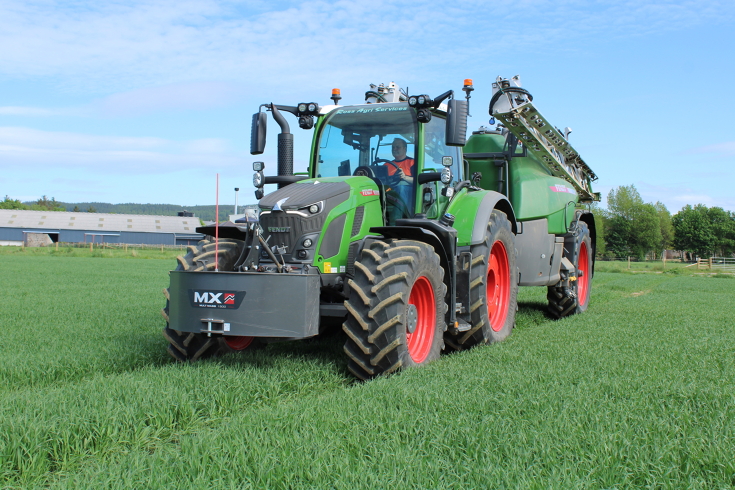
Bought from dealer Ross Agri as an ex-demonstrator in the summer of 2025, the 620 has already clocked up 900 hours and is likely to do 1200 in 12 months. It has been set to task with the farm’s Bunning spreader where its GPS has helped variable rate lime application. It has also worked well when coupled to a Lemken 5 furrow on-land plough and had a busy autumn and spring with a Lemken 4m power harrow combi drill.
“For me, the key is the four-wheel drive system and the single gear Vario transmission. It is compact, with a tight turning circle which helps, but it is the delivery of power that is smoother than any other tractor I have operated. It is superb on the road, which is important to us because we have two farms that are 25 miles apart,” he says.
The 620 Vario can reach a top speed of up to 50 km/h at 1,250 rpm and offers 950 Nm from 1,200 rpm to 1,600 rpm. With a power-to-weight ratio of 34.4 kg per hp, the 600 Vario is also very manoeuvrable, providing a turning circle of just 10.2 metres with 540/65 R30 tyres.
Fendt’s VarioDrive transmission features a single stage drive train which measures the slip on all four wheels to regulate power output. Minimising wheel slip using Fendt’s dynamic control system also provides greater traction whilst reducing soil compaction.
Less fuel, more efficiency
“We have had the chance to compare it directly with our 724 Gen6 because we have two identical Lemken 5 furrow on-land ploughs. In the same field, at the same speed, and ploughing at the same depth, the 620 was using three litres less fuel an hour. It was clocking 28 litres an hour, making it roughly 10% more fuel efficient than the Gen6,” he explains.
The 620 allows for a total weight of 13.5 tonnes from a unladen weight of 7.7 tonnes, so almost double. Matthew uses 300 kilo wheel weights and a front ballast of 1.5 tonnes to manage the plough.
“It makes so much sense to have a tractor that is so versatile. On the road and for light work it is using less fuel and feels nimbler, but, when ballasted up and doing the work typically associated with larger tractors, it still feels planted and steady,” he adds.
Smart Farming and spraying
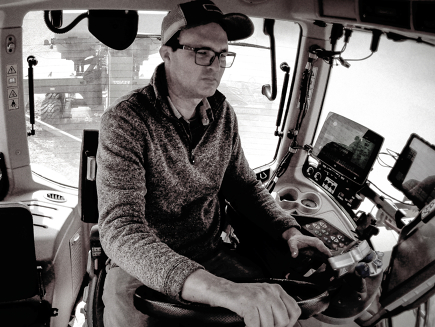
The latest Fendt cab layout in the 620 is an ergonomic, comfortable and peaceful place to work. The FendtONE operating system is facilitated by a multifunction joystick, 10-inch digital dashboard and a 12-inch terminal on the armrest. Matthew’s model also features Fendt’s 3L joystick and another 12-inch terminal which are available as options on the Profi Plus specification 620. This means smart functions such as the Fendt Guide guidance system, automatic section control and variable rate control, are all displayed through easy to access tiles on the terminals.
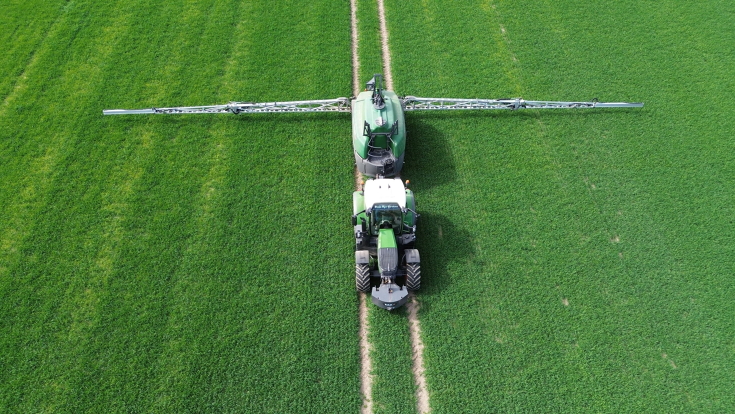
“We have a six-year-old Fendt trailed Rogator sprayer. It is an excellent machine with individual nozzle control and a 6800 litre tank. Because it’s trailed we don’t have to tie up a tractor when it comes to spraying and it is a perfect companion for the 620,” he says.
Fendt ceased production of the trailed Rogator range in 2022 but the technology that was provided has stood the test of time well.
“The 620’s hydraulic pump suits the sprayer well and the tractor has no problem managing the weight of 6800 litres with a 900-litre wash tank. The screens also enable the ISOBUS, GPS and tractor controls to be open at the same time, which makes spraying so much easier,” he says.
At home in challenging conditions
The farm has fairly light soils but, with steep slopes and lot of shingle, the land is not without its challenges.
“We have small fields, tight gates, rivers and steep slopes, so pretty much everything that makes field work difficult. But the 620 has better traction than heavier tractors we have used because of the torque curve and the four-wheel drive, so feels somehow at home here,” he says.
Backup and support from Ross Agri has always instilled him with confidence, but, other than a 500-hour first service, the 620 has not needed anything else.
“Our Fendts have been largely trouble free. It is good to have the Ross Agri team on hand for help, advice and backup but thankfully it is rarely needed. Reliability and service over the years have only given us greater confidence to invest in more Fendt machinery,” he says.
30% of the 620’s time is spent on the road, often pulling 16 and 18 tonne trailers, which Matthew suggests it handles well.
“It handles very well on the road and never seems to lack grunt. It feels every bit as powerful as the 724 Gen6 and I would have another 620 instead of a 700 series Gen7 because of it’s compact proportions, better economy and cheaper purchase price,” he concludes.
What I've noticed with the Fendt is the fuel economy. As long as you're not foot to the floor, you're getting a lot better fuel economy than other tractors.
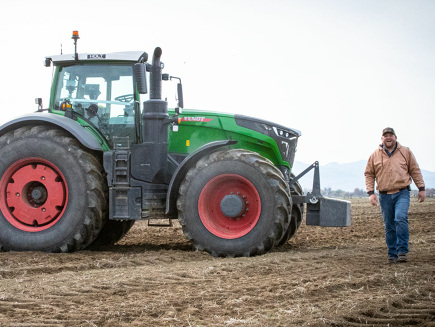
Neil Anderson, farmer, Northern California, USA - Fendt 1038, 1042, and 1046 Vario Tractors
Neil Anderson, farmer, Northern California, USA - Fendt 1038, 1042, and 1046 Vario Tractors
What I've noticed with the Fendt is the fuel economy. As long as you're not foot to the floor, you're getting a lot better fuel economy than other tractors.